

Surface Poisson DG#
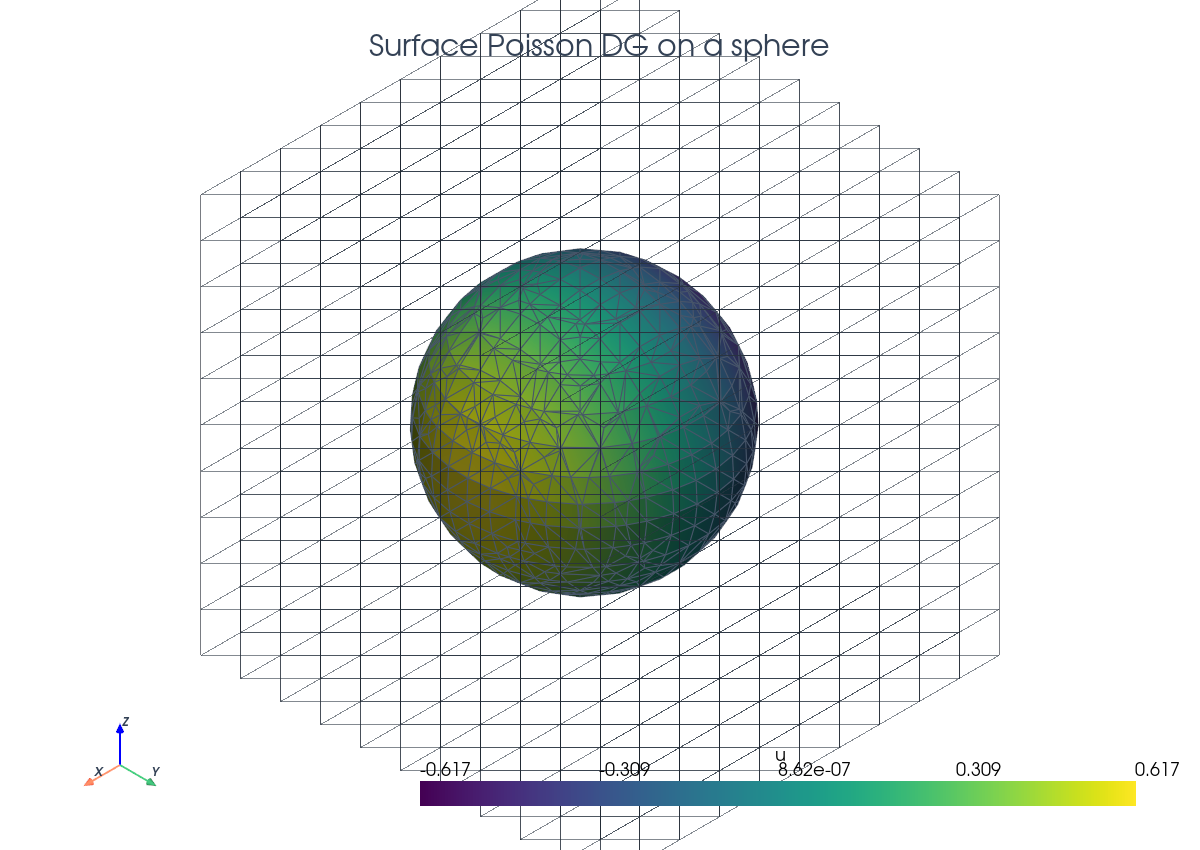
This tutorial follows python/demo/demo_surface_poisson_dg.py. The unknown is
defined on an embedded surface rather than in one phase of a cut volume. The
demo uses a hexahedral background mesh and builds the surface mesh from
CutFEMx’s "phi=0" cut geometry.
The surface CutFEM and cut DG ingredients are related to the references in the
related literature below.
Model Problem#
Let \(\Gamma=\{x:\phi(x)=0\}\) be a sphere of radius \(R=0.62\) centered at \(c=(0.05,-0.03,0.02)\). The demo solves
with manufactured solution \(u_\mathrm{ex}=x_0-c_0\). On the sphere this gives
Implementation Order#
The demo executes the surface solve in this order:
Define the level set function.
Build the hexahedral background mesh and interpolate a quadratic level set.
Cut cells with
"phi=0"and create Algoim surface quadrature.Build the active surface skeleton by cutting interior facets adjacent to the cut cells; use those same surface skeleton facets as the ghost set.
Build
dx_gamma,dS_gamma, anddS_ghost.Build the DG space, tangential gradients, conormal jumps, SIPG terms, and ghost stabilization.
Assemble, deactivate inactive dofs, solve, compute exact/error fields and the surface measure, then write background, XDMF preview, and DG VTK output.
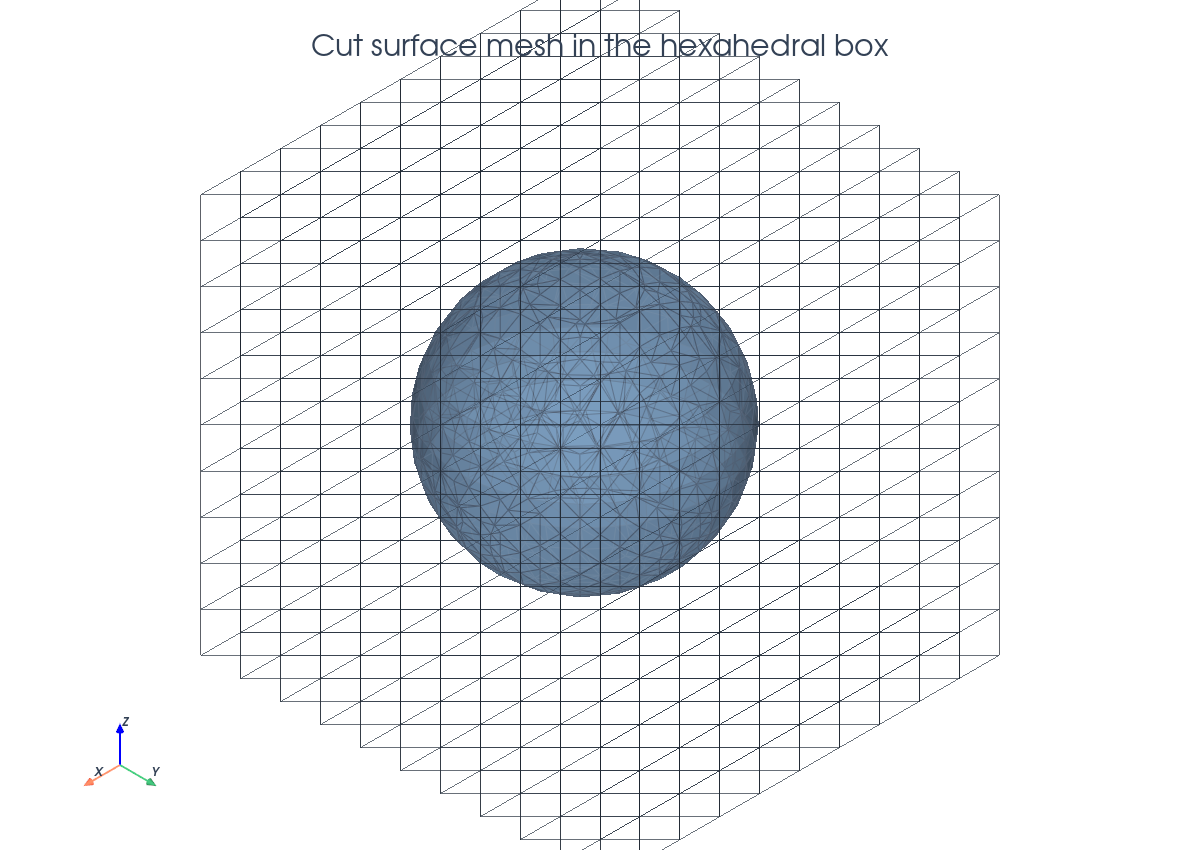
Background Mesh And Cut Surface#
The level set is interpolated into a quadratic Lagrange space on the
background hexahedral mesh. Cells intersected by the zero level set are found
with the "phi=0" predicate.
msh = mesh.create_box(
    comm,
    (np.array([-1.0, -1.0, -1.0]), np.array([1.0, 1.0, 1.0])),
    (n, n, n),
    cell_type=mesh.CellType.hexahedron,
)

V_phi = fem.functionspace(msh, ("Lagrange", 2))
phi = fem.Function(V_phi, name="phi")
phi.interpolate(lambda x: squared_distance(x, center) - radius**2)
phi.x.scatter_forward()

cell_cut = cutfemx.cut(phi)
cut_cells = cutfemx.locate_entities(cell_cut, "phi=0")
Surface Quadrature#
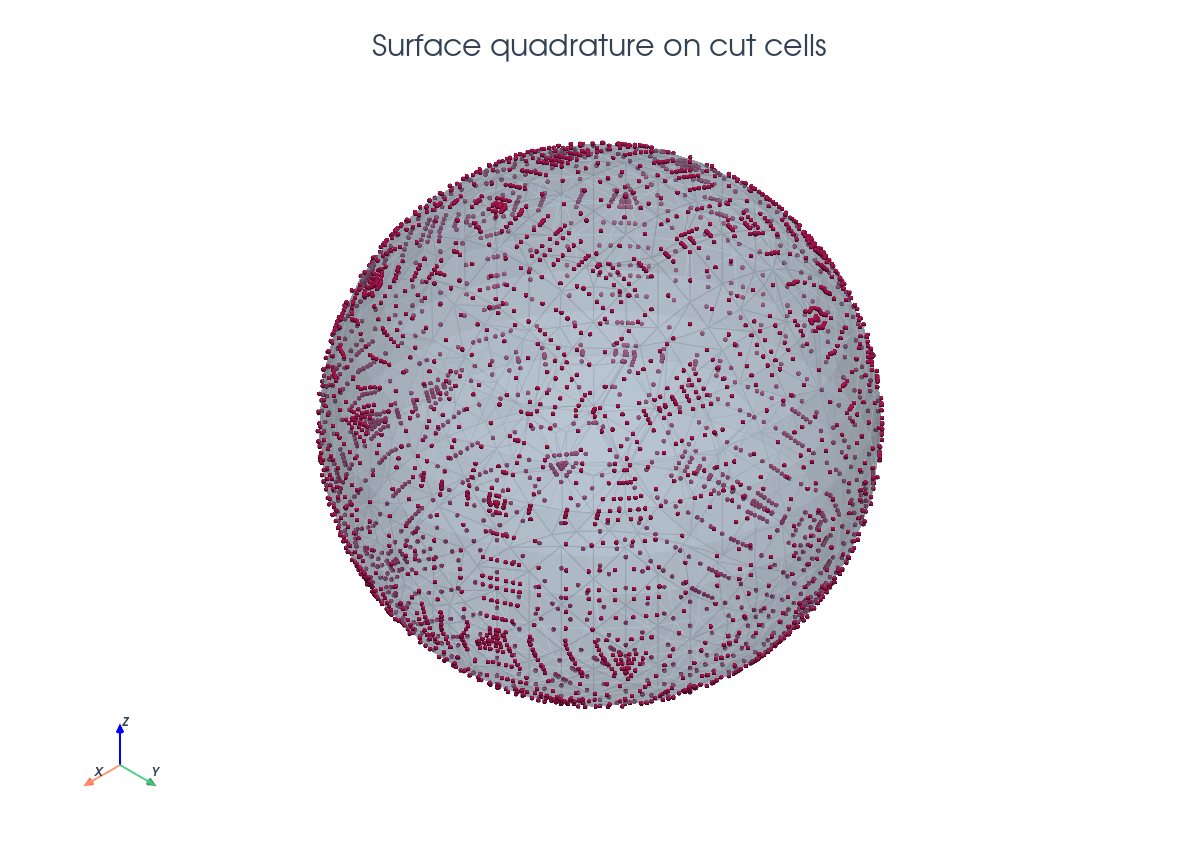
CutFEMx generates quadrature points directly on \(\Gamma\cap K\) for each cut
background cell. The demo uses the algoim backend for the surface rules.
gamma_rules = cutfemx.runtime_quadrature(
    cell_cut, "phi=0", quadrature_order, backend="algoim"
)
dx_gamma = ufl.Measure("dx", domain=msh, subdomain_data=gamma_rules)
Tangential Differential Operators#
The surface gradient is obtained by projecting the background gradient into the tangent plane:
n_gamma = cutfemx.normal(phi)
I = ufl.Identity(msh.geometry.dim)
P = I - ufl.outer(n_gamma, n_gamma)
grad_G_u = ufl.dot(P, ufl.grad(u))
grad_G_v = ufl.dot(P, ufl.grad(v))
DG Skeleton On The Surface#
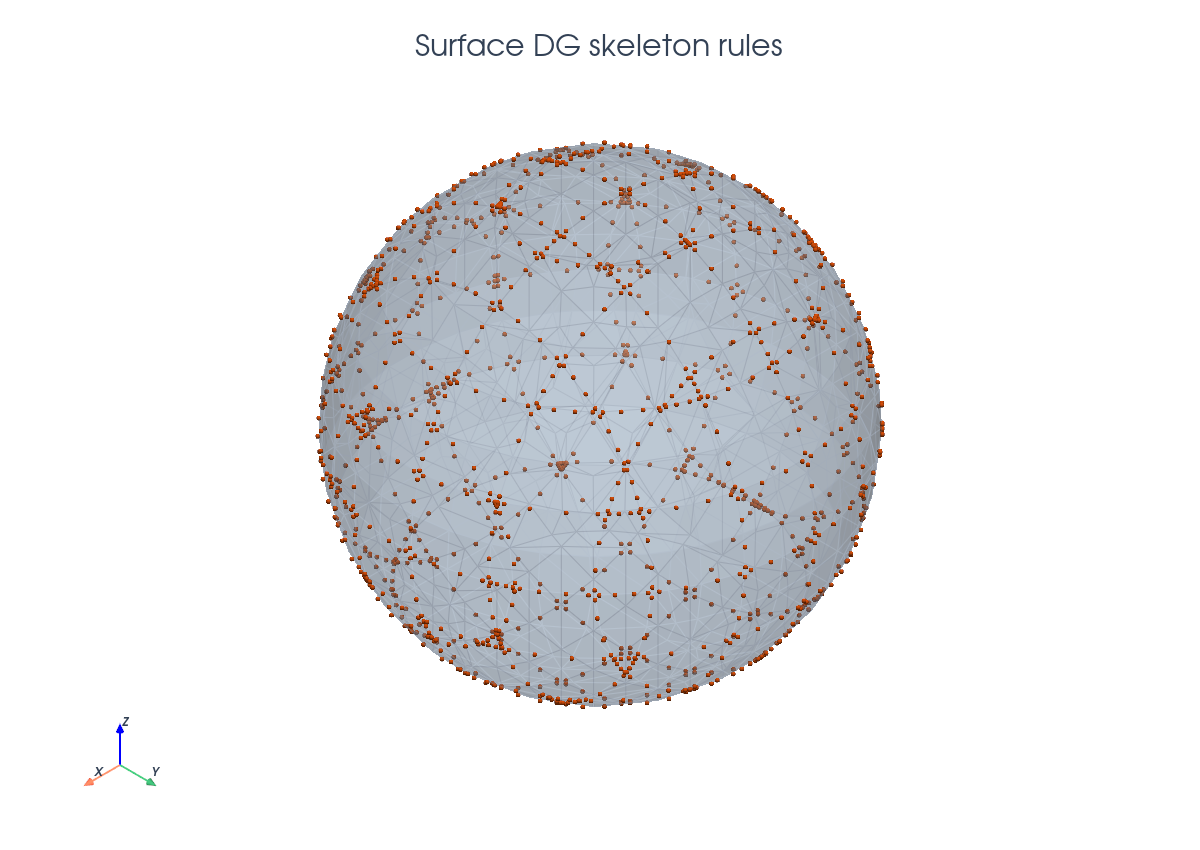
The DG skeleton is formed from interior facets adjacent to cut cells. Those facets are cut again by the level set, this time as lower-dimensional entities.
skeleton_facets = cutfemx.interior_facets_for_cells(msh, cut_cells)
facet_cut = cutfemx.cut(phi, skeleton_facets, facet_dim)
skeleton_rules = cutfemx.runtime_quadrature(
    facet_cut, "phi=0", quadrature_order, backend="algoim"
)
ghost_facets = cutfemx.locate_entities(facet_cut, "phi=0")

dS_gamma = ufl.Measure("dS", domain=msh, subdomain_data=skeleton_rules)
dS_ghost = ufl.Measure("dS", domain=msh, subdomain_id=2, subdomain_data=ghost_facets)
The SIPG terms use conormals from CutFEMx:
mu = cutfemx.conormal(n_gamma)
jump_u_mu = ufl.jump(u, mu)
jump_v_mu = ufl.jump(v, mu)
Assembly And Output#
The bilinear form combines the surface reaction-diffusion operator, skeleton consistency terms, SIPG penalty, and optional ghost stabilization:
The forms are compiled as CutFEMx runtime forms, assembled into a serial sparse
MatrixCSR system, and then deactivated outside the active surface problem
before the SciPy solve. The computed surface field uh still lives on the
background DG space; the cut-surface output step restricts it to the
visualization mesh later.
a_form = cutfemx.fem.form(a)
L_form = cutfemx.fem.form(L)

A = cutfemx.fem.assemble_matrix(a_form)
A.scatter_reverse()
b = cutfemx.fem.assemble_vector(L_form)
b.scatter_reverse(la.InsertMode.add)

cutfemx.fem.deactivate_outside(A, b, cutfemx.fem.active_domain(a_form))

from scipy.sparse.linalg import spsolve

uh = fem.Function(V, name="u_h")
uh.x.array[:] = spsolve(A.to_scipy().tocsr(), b.array)
uh.x.scatter_forward()
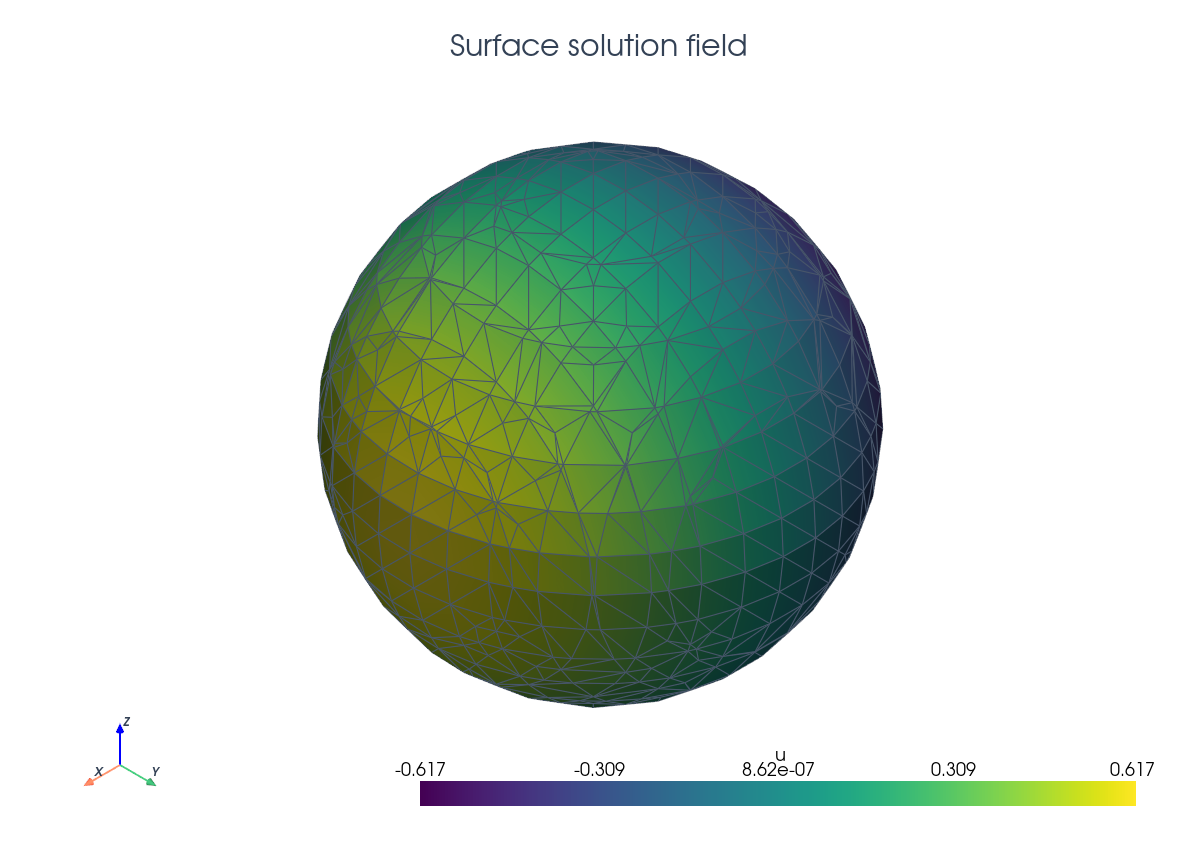
The script writes:
surface_poisson_dg_xdmf/surface_poisson_dg_background.xdmfsurface_poisson_dg_xdmf/surface_poisson_dg_gamma.xdmfsurface_poisson_dg_xdmf/surface_poisson_dg_gamma_dg.pvd
Run The Demo#
python python/demo/demo_surface_poisson_dg.py
Full Source#
The complete source remains available in the repository: python/demo/demo_surface_poisson_dg.py.