Cell Shapes#
This tutorial follows python/demo/demo_cell_shapes.py. The API does not change
with the shape of the background cell, but the cost and the accuracy do. The
demo cuts one disk or ball on triangles, quadrilaterals, tetrahedra, hexahedra,
prisms and pyramids, with both backends.
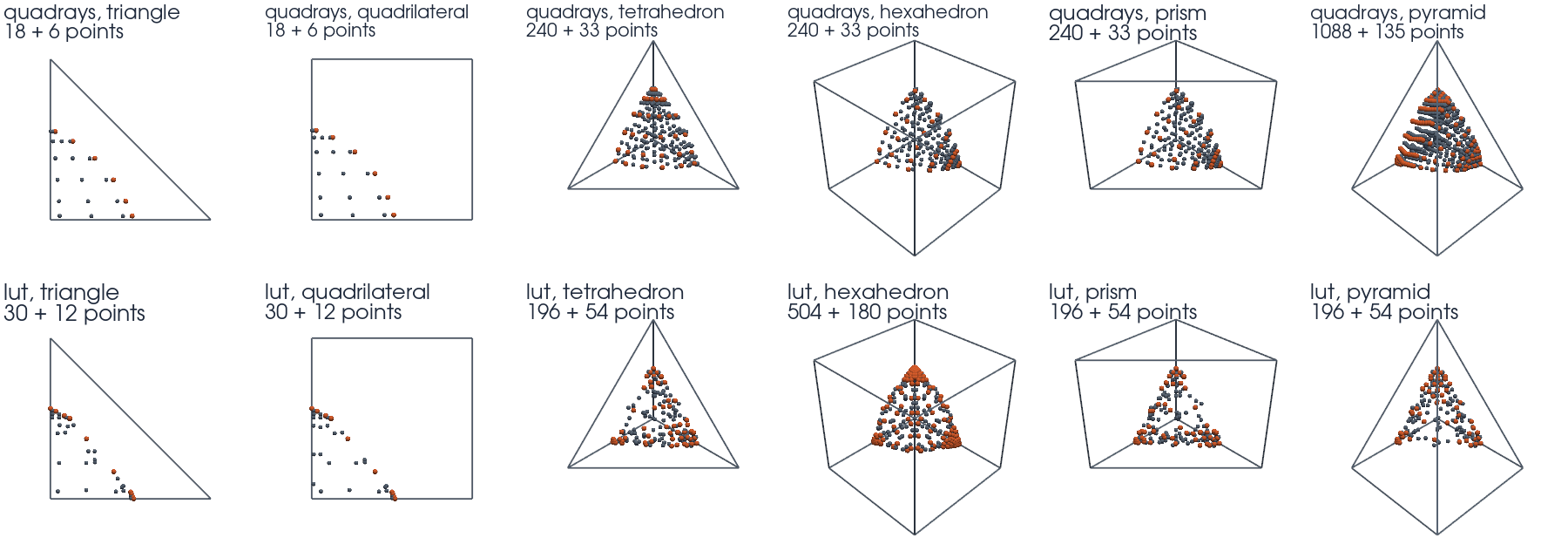
One Workflow#
box_mesh builds all four 3D shapes on the same grid: hexahedra, six tetrahedra
or two prisms per grid cell, or six pyramids around a node at its centre.
mesh = cutcells.box_mesh(-1, -1, -1, 1, 1, 1, n, n, n, cell_type=shape)
phi = cutcells.create_level_set(mesh, round_shape, degree=degree, name="phi")
result = cutcells.cut(mesh, phi, backend=backend)
volume = result[phi < 0].quadrature(order=order)
surface = result[phi == 0].quadrature(order=order)
The geometry is the disk or ball of radius 0.6 about \((0.1, -0.05, 0.03)\), with 13 grid points per side and order 6. The errors are those of the total area or volume against the exact values. Level sets on pyramids take degree 2 at most; the others use P3.
Curved Pieces#
         shape   backend  cells  marked cut  on surface  all points  per surface cell  seconds  volume err  area err
      triangle  quadrays    288          49          49        2115            37 + 6    0.019     2.3e-06   3.7e-06
      triangle       lut    288          49          48        5220           94 + 15    0.006     1.6e-03   1.5e-03
 quadrilateral  quadrays    144          29          29        1119            32 + 6    0.004     1.8e-06   3.0e-06
 quadrilateral       lut    144          29          28        3812          121 + 15    0.006     2.0e-03   2.0e-03
   tetrahedron  quadrays  10368        1106        1106      713843          600 + 46    2.652     1.1e-06   2.8e-06
   tetrahedron       lut  10368        1106        1104      941304         703 + 150    0.514     4.5e-03   8.3e-03
    hexahedron  quadrays   1728         242         242      164353          610 + 69    0.610     9.5e-08   4.0e-07
    hexahedron       lut   1728         242         241      973248        3387 + 651    0.710     3.9e-03   1.0e-02
         prism  quadrays   3456         447         434      274628          577 + 56    0.993     8.4e-07   2.5e-06
         prism       lut   3456         447         433      952824        1837 + 363    0.571     3.9e-03   9.7e-03
       pyramid  quadrays  10368         999         999     1915069        1758 + 159   11.381     2.2e-06   1.8e-05
       pyramid       lut  10368         999         996      569688         464 + 108    0.326     5.2e-03   1.2e-02
Hexahedra give the most for the points. On the same grid, the P3 level set has the same 50653 nodes on hexahedra and on tetrahedra, but on the hexahedra, with their tensor space, the errors are about ten times lower, and the mesh takes 4.3 times fewer points in all. Each cut cell takes about as many points, and there are 4.6 times fewer cut cells. In 2D the difference in accuracy is small.
Prisms lie between. Their errors are close to those of tetrahedra, at under twice the points of hexahedra.
The backends differ by three orders of magnitude or more. quadrays integrates the curved region, so its error is the interpolation error. The lookup tables integrate straight pieces, so their error is that of the pieces: 1e-3 to 1e-2 on every shape here. In exchange they are faster on tetrahedra (about five times) and prisms (about two times), and they take as long on hexahedra. Their points are many on these 3D cells because each cell is refined into straight pieces, each with its own rule. The next chapter compares them point for point.
Pyramids take more points
A pyramid’s Pk level set is rational in its reference coordinates. cut tests
its sign on the cube of the collapsed coordinates \((s, t, z)\), with
\(x = (1-z)s\) and \(y = (1-z)t\), where it is a polynomial, so it marks exactly the
999 pyramids that hold the surface. quadrays integrates \((1-z)^n \phi\) instead,
a polynomial of degree \((n, n, 2n)\) with the same zero set inside the pyramid.
The doubled degree along \(z\) costs about three times the points per cut cell of
a hexahedron with P3, at a similar accuracy: 11 s here, against 0.6 s on hexahedra. Use
pyramids where a mesh already has them, not by choice.
Straight Pieces#
A P1 level set on simplices has flat zero sets, so both backends integrate the same region:
P1 level set, order 2
         shape   backend  per surface cell  seconds            volume              area
      triangle  quadrays             6 + 2    0.002    1.115879804252    3.756096790720
      triangle       lut             4 + 3    0.001    1.115879804252    3.756096790720
 quadrilateral  quadrays             6 + 2    0.002    1.116324052807    3.753200164792
 quadrilateral       lut             6 + 3    0.001    1.112321349703    3.751932405214
   tetrahedron  quadrays            74 + 6    0.120    0.869795779371    4.432990117310
   tetrahedron       lut             8 + 4    0.033    0.869795779371    4.432990117310
    hexahedron  quadrays            55 + 7    0.043    0.869842666698    4.426668513021
    hexahedron       lut           40 + 18    0.035    0.869795779371    4.432990117310
         prism  quadrays            81 + 9    0.125    0.869796622629    4.428779762676
         prism       lut           22 + 10    0.040    0.869858275018    4.436001169845
       pyramid  quadrays          320 + 27    3.007    0.882907281801    4.469140691487
       pyramid       lut            15 + 7    0.089    0.882915325565    4.473450725907
On triangles and tetrahedra the two agree to all 12 digits, and the lookup tables need far fewer points: 8 + 4 against 74 + 6 on a tetrahedron. That is their place: a P1 level set on a simplex, where they are exact for the region it describes.
On the other shapes the two answer different questions. The P1 level set of a quadrilateral or hexahedron is multilinear, so its zero set is curved. quadrays integrates that curved set and the lookup tables a straight approximation of it. The hexahedra’s lookup tables even give the tetrahedral mesh’s numbers to all 12 digits.
Run the Demo#
python python/demo/demo_cell_shapes.py
python python/demo/demo_cell_shapes.py --n 9 --order 4 --no-plot
Options: --n grid points per side, --order of the quadrature, --no-plot to
skip the PyVista window and --screenshot file.png to save the view.