Points and Accuracy#
This tutorial follows python/demo/demo_points_accuracy.py. What matters in
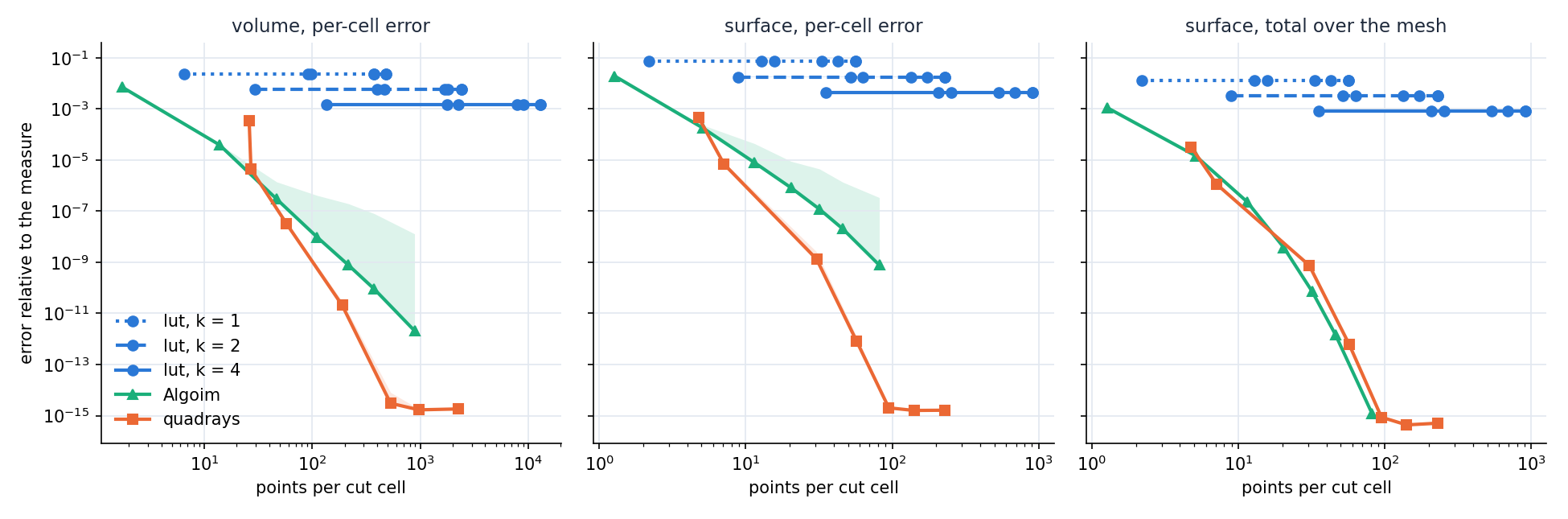
assembly is the error a rule reaches for its number of points. The demo compares
four kinds of rule on one sphere: the lookup tables, plain quadrays points,
quadrays’ defaults, and Algoim.
The Rules#
The level set is the quadratic \(|x-c|^2-R^2\) with \(R=0.7\), interpolated exactly by P2, so only the rule’s error remains. The mesh has 16 grid cells per side, each a hexahedron or six tetrahedra. Below, \(q\) is the points per segment and sets the accuracy of quadrays’ rules, as the order does.
def quadrays_options(q, plain):
    options = cutcells.QuadraysOptions()
    options.points_per_segment = q
    if plain:
        options.anchor_folds = 0
        options.tolerance = -1.0
    return options

rules = result[phi == 0].quadrature(order=10, mode="cut_only", options=quadrays_options(q, False))
lut = result[phi == 0].quadrature(order=4, mode="cut_only", backend="lut",
                                  options=cutcells.LutOptions(template_order=k))
quadraysThe defaults: points anchored at the folds of the height functions, and an accuracy check that bisects a box when its moments do not settle.
plainGauss points along the height directions, with no anchoring or check. This is the construction of Saye (2015).
lut, kThe lookup tables: the level set’s cell is refined into \(k\) parts per edge and each part is cut along straight lines.
AlgoimAlgoim, Saye’s library, driven through the comparison programs in
benchmarks/quadrays.
On hexahedra, plain quadrays and Algoim’s Gauss rule are the same rule. In
quadrays_study they give equal point counts and errors, to all printed digits:
mesh    n  q generator      part     |     cut |  pts/cut |    global        L1     worst | bisect uncert |   us/cut
hex    16  5 quadrays-f0:0.25:-1 phi < 0  |     591 |    214.5 |   5.1e-12   7.7e-11   3.0e-07 |      0      0 |     85.8
hex    16  5 algoim-gl      phi < 0  |     591 |    214.5 |   5.1e-12   7.7e-11   3.0e-07 |      0      0 |    359.9
hex    16  5 quadrays-f0:0.25:-1 phi = 0  |     591 |     31.7 |   5.9e-11   3.4e-09   8.6e-07 |      0      0 |     83.8
hex    16  5 algoim-gl      phi = 0  |     591 |     31.7 |   5.9e-11   3.4e-09   8.6e-07 |      0      0 |    271.2
So any difference in the figure comes from what quadrays adds, and not from different underlying rules. (These errors are relative to the measure; the tables below are absolute.)
Lookup Tables Stop Early#
hexahedron, cut cells: 591; q is the points per segment (the order for lut)
    part       rule  q  points/cut  us/cut  per-cell err  total err
  volume lut, k = 1  1         6.5      27       3.4e-02    3.4e-02
  volume lut, k = 1  4        90.5      38       3.4e-02    3.4e-02
  volume lut, k = 2  1        29.2      80       8.6e-03    8.6e-03
  volume lut, k = 2  4       429.9     166       8.6e-03    8.6e-03
  volume lut, k = 4  1       134.7     382       2.1e-03    2.1e-03
  volume lut, k = 4  4      2153.2    1246       2.1e-03    2.1e-03
A higher order changes nothing: the straight pieces integrate the wrong region,
and the order only integrates it more exactly. Refining falls as \(k^{-2}\), like
refining the mesh, and the points grow more than fourfold per doubling. quadrays’
smallest rule, 25 points at \(q = 1\), already reaches 5.6e-4, a quarter of the error
of k = 4 with its 134.7 points.
So keep the lookup tables for what they do well: flat zero sets (see Cell shapes) and low accuracy at small cost per cell.
What Anchoring and the Check Buy#
hexahedron
    part       rule  q  points/cut  us/cut  per-cell err  total err
  volume   quadrays  3        58.9     107       4.6e-08    2.5e-09
  volume   quadrays  4       192.7     185       3.8e-11    2.1e-11
  volume   quadrays  5       512.2     372       3.8e-15    5.6e-16
  volume      plain  3        46.3      22       3.2e-07    4.6e-08
  volume      plain  5       214.5      38       1.1e-10    7.3e-12
  volume      plain  6       370.6      60       4.4e-12    1.1e-13
  volume      plain  8       878.5     116       1.7e-14    0.0e+00
 surface   quadrays  3        29.6     189       5.8e-09    4.0e-09
 surface   quadrays  4        54.8     262       5.1e-12    3.8e-12
 surface   quadrays  5        92.0     400       8.3e-15    2.7e-15
 surface      plain  5        31.7      68       2.1e-08    3.6e-10
 surface      plain  6        45.7      80       1.4e-09    7.2e-12
 surface      plain  8        81.2     103       8.7e-12    3.6e-15
Compare rows of about equal points. At about 30 surface points quadrays is about four times better per cell, by 50 about 300 times, and by 80 to 90 about 1000 times, and it continues to round-off. On the volume, the gain at 200 points is about three times.
The rest of the comparison is less flattering, so here it is plainly:
Plain points are better at the totals on hexahedra. At about 30 surface points plain has a total error of 3.6e-10 against 4.0e-9, and the figure’s right panel shows the same for Algoim. Errors of neighbouring cells cancel, and more so for plain points. If you only need an integral over the whole surface of a smooth function, plain points do well.
The defaults take more time. quadrays spends about 5 to 10 times as long as plain points at the same \(q\), in the check and on the extra factors. Timings are from a busy machine, so read them for their size only.
The worst placement matters. The green band in the figure is what per-cell numbers show and medians hide: at \(q = 8\) Algoim’s volume error is 2.1e-12 for the median placement and 1.3e-8 for the worst, and its surface error 7.8e-10 and 3.4e-7. quadrays stays within a factor of about three over the 16 placements.
Tetrahedra Gain the Most#
On tetrahedra, plain points stall, and the totals do not rescue them:
tetrahedron, cut cells: 2698
    part       rule  q  points/cut  us/cut  per-cell err  total err
  volume   quadrays  4       221.6     279       6.0e-11    1.9e-11
  volume   quadrays  5       493.2     447       8.0e-14    2.9e-14
  volume      plain  4       196.6     354       1.6e-08    4.0e-09
  volume      plain  6       663.7     356       1.3e-10    8.1e-11
  volume      plain  8      1573.2     587       2.6e-12    2.1e-12
 surface   quadrays  4        40.7     647       6.2e-11    3.0e-11
 surface   quadrays  5        71.1     808       5.8e-14    3.1e-14
 surface      plain  5        41.7     199       4.3e-07    2.5e-07
 surface      plain  6        60.1     187       6.4e-08    4.7e-08
 surface      plain  8       106.8     254       2.0e-09    1.8e-09
At about 60 surface points, quadrays is six orders of magnitude better than plain points, per cell and in total.
Which rule to use
A P1 level set on simplices, or low accuracy cheaply:
backend="lut".Curved geometry, assembled cell by cell: quadrays’ defaults, the order you need from Degree and order.
Whole-surface integrals on hexahedra, at many evaluations:
anchor_folds = 0andtolerance = -1are worth trying; check the accuracy on your geometry.Fewer points whatever the generator: Compression.
Run the Demo#
python python/demo/demo_points_accuracy.py
python python/demo/demo_points_accuracy.py --cell-type tetrahedron --no-plot
Options: --cell-type of the mesh, --n grid points per side, --sweep file.csv
to add the Algoim curves to the plot, --no-plot to skip the matplotlib window
and --screenshot file.png to save the plot.
The Algoim data of the figure come from the benchmarks, which need the
-DCUTCELLS_WITH_ALGOIM=ON build of benchmarks/:
quadrays_sweep --mesh hex --n 16 --steps 16 --q 1,2,3,4,5,6,8 --gen quadrays,lut:1,lut:2,lut:4,algoim --csv sweep.csv
quadrays_study --mesh hex --n 16 --q 3,5,8 --radius 0.7 --centre 0.0123,-0.0371,0.0217 --gen quadrays-f0:0.25:-1,algoim-gl --part 'phi < 0' --part 'phi = 0'