Gyroid#
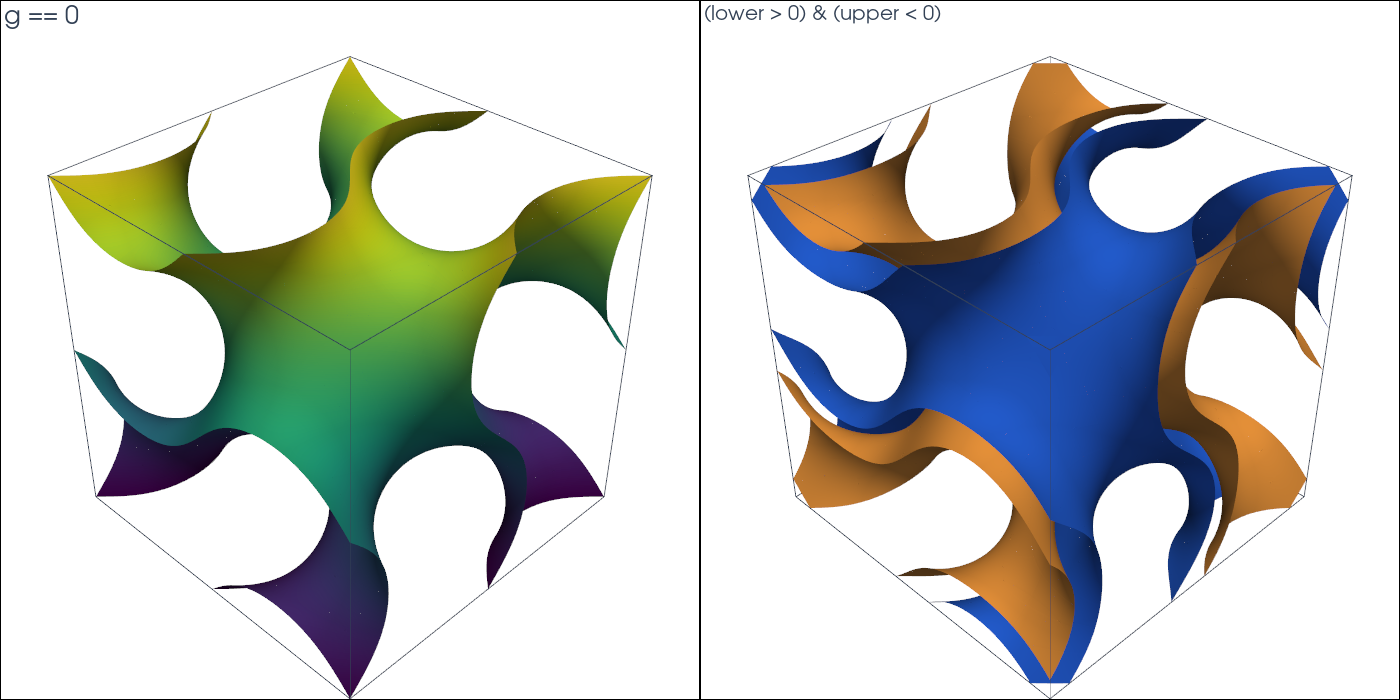
This tutorial follows python/demo/demo_gyroid.py. A triply periodic minimal
surface, the gyroid, is cut out of a hexahedral mesh, and a sheet around it
is selected between two level sets.
Geometry#
On the unit cell \([0,L]^3\) the gyroid is approximated by the zero set of
It splits the cell into two congruent labyrinths, so each of \(\{g<0\}\) and \(\{g>0\}\) fills exactly half of the cell, and its area in one cell is about \(3.09\,L^2\). Lattices of this kind are used for lightweight structures, heat exchangers and scaffolds.
Hexahedral Mesh#
box_mesh(..., cell_type="hexahedron") builds a box of hexahedra in VTK node order;
n = 17 points per side give 4096 cells. The level set is a P3 interpolant
of \(g\):
mesh = cutcells.box_mesh(0.0, 0.0, 0.0, LENGTH, LENGTH, LENGTH, n, n, n, cell_type="hexahedron")
g = cutcells.create_level_set(mesh, gyroid, degree=3, name="g")
result = cutcells.cut(mesh, g)

fraction = result[g < 0].quadrature(order=4).weights.sum() / LENGTH**3
area = result[g == 0].quadrature(order=4).weights.sum() / LENGTH**2
Quadrilaterals and hexahedra are cut like simplices. quadrays integrates
affine cells, such as these parallelepipeds; the lookup tables
(backend="lut") also take general quadrilaterals, hexahedra, prisms and
pyramids.
A Sheet Between Two Level Sets#
The sheet \(\{-t<g<t\}\) is the part between the level sets \(g+t\) and \(g-t\), both inside the cell:
lower = cutcells.create_level_set(mesh, lambda X: gyroid(X) + SHEET, degree=3, name="lower")
upper = cutcells.create_level_set(mesh, lambda X: gyroid(X) - SHEET, degree=3, name="upper")
sheet_result = cutcells.cut(mesh, [lower, upper])

sheet = sheet_result[(lower > 0) & (upper < 0)]
faces = sheet_result[lower == 0], sheet_result[upper == 0]
The sheet’s volume comes from its quadrature; its two faces are drawn in the view above.
Results#
hexahedra: 4096, cut by g: 1248
volume fraction of g < 0:  0.500000000000  (exact 1/2, error 3.4e-14)
area of g = 0, quadrays:   3.09164528 L^2
area of g = 0, lut:        3.09422760 L^2
volume fraction of sheet:  0.25832662
The volume fraction is exact up to the quadrature error, as the interpolant keeps the point symmetry \(g(L-x)=-g(x)\) that swaps the two labyrinths. The area has no closed form; the straight pieces of the lookup tables differ from the curved pieces of quadrays by \(2.6\cdot10^{-3}\), almost \(10^{-3}\) relative, on this mesh.
Run the Demo#
python python/demo/demo_gyroid.py
python python/demo/demo_gyroid.py --n 33 --no-plot
Options: --n grid points per side, --degree of the level sets, --order
of the quadrature, --output-dir for the VTU files, --no-plot and
--screenshot file.png.