Integrating Functions#
This tutorial follows python/demo/demo_ellipsoid.py. A quadrature rule is
points and weights, so it integrates any function. On a rotated ellipsoid the
demo checks moments of the volume and, with normals from the level set, the
divergence theorem.
Geometry#
The ellipsoid has semi-axes \((a_1,a_2,a_3)=(0.8,0.55,0.35)\) and centre \(x_0\), in axes turned by a rotation \(Q\). With \(y=Q(x-x_0)\),
This is no signed distance, which CutCells does not need. The exact values are
Points in Physical Space#
The rules hold, per background cell, reference points and physical weights. On a simplex mesh the cell’s vertices map the points:
rules = result[phi < 0].quadrature(order=6, mode="full")

reference = rules.points.reshape(-1, 3)
cells = np.repeat(rules.parent_map, np.diff(rules.offset))
x = mesh.coordinates[mesh.connectivity.reshape(-1, 4)[cells]]
points = x[:, 0] + np.einsum("pi,pig->pg", reference, x[:, 1:] - x[:, :1])

centroid = rules.weights @ points / rules.weights.sum()
Normals and the Divergence Theorem#
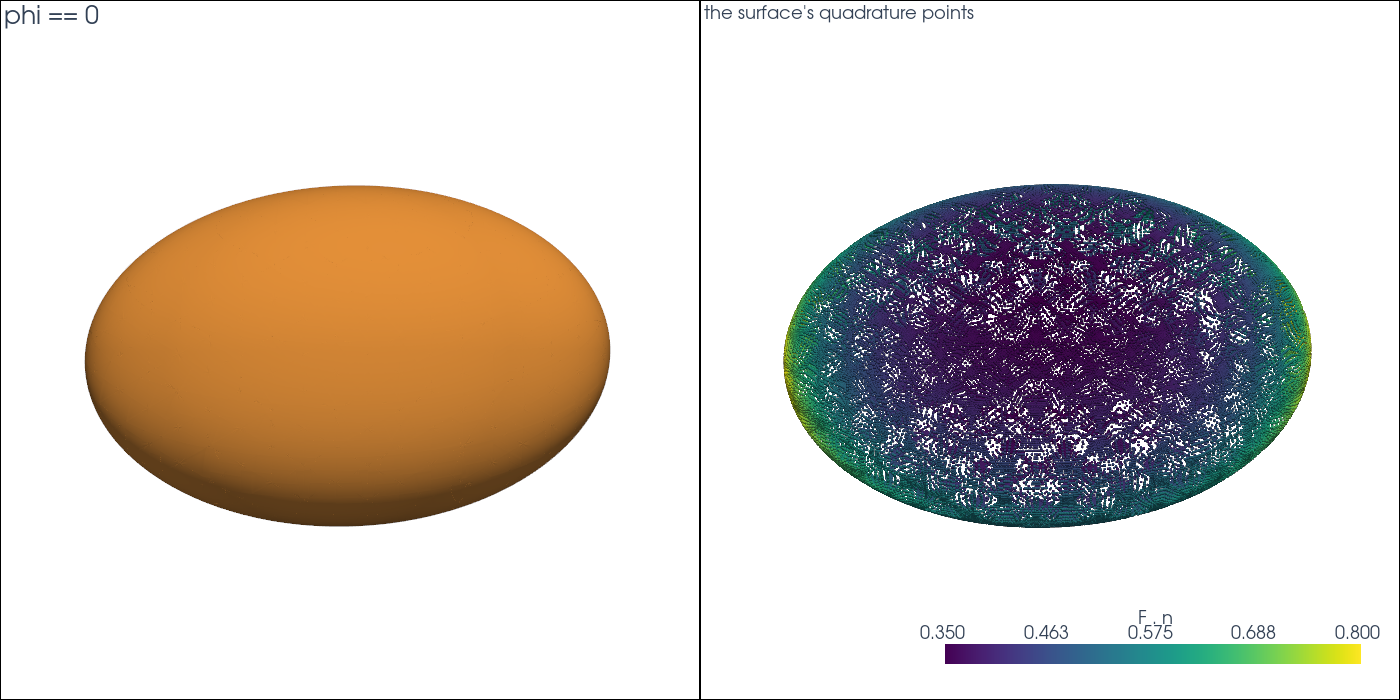
The weights of a surface rule are surface measures, and the normal at a point is the gradient of the level set, scaled. The field \(F(x)=x-x_0\) has divergence 3, so
which ties the surface rule to the volume rule:
surface = result[phi == 0].quadrature(order=6)
xs = physical_points(mesh, surface)
flux = np.dot(surface.weights, np.sum((xs - CENTER) * normals(xs), axis=1))
Results#
For a P3 level set on 24576 tetrahedra:
tetrahedra: 24576, cut cells: 1959
        quantity          computed             exact      error
          volume    0.645072721701    0.645073691537   9.70e-07
  flux of x - x0    1.935250556244    1.935221074611   2.95e-05
      centroid x    0.040000446944    0.040000000000   4.47e-07
      centroid y   -0.029999061579   -0.030000000000   9.38e-07
      centroid z    0.019999596705    0.020000000000   4.03e-07
       int y_1^2    0.082571834412    0.082569432517   2.40e-06
       int y_2^2    0.039027615843    0.039026958338   6.58e-07
       int y_3^2    0.015803460848    0.015804305443   8.45e-07
surface area: 3.9492319027 (no closed form)
The errors belong to the P3 interpolant. From \(n=17\) to \(n=33\) the volume error falls to 1.9e-8 and the flux error to 2.1e-6.
Run the Demo#
python python/demo/demo_ellipsoid.py
python python/demo/demo_ellipsoid.py --n 33 --no-plot
Options: --n grid points per side, --degree of the level set, --order of
the quadrature, --output-dir for the VTU files, --no-plot and
--screenshot file.png.